
One of the first things we do with a new deck is pull out the King of Hearts, along with the Ace of Spades and the Jokers. It’s become a bit of a ritual here, because they’re usually the most fun to look at, and they’re where designers tend to really put their stamp on the deck. Some play it safe and keep him classic. Others clearly couldn’t help themselves and have tucked in something sly.
He’s also got that grim little nickname, the suicide king, which sounds like someone trying to be edgy at a card table… until you look properly. In a lot of standard English-style playing cards, the King of Hearts has a sword that disappears behind his head. If you catch it in your peripheral vision while you’re shuffling, it can genuinely look like he’s doing something dramatic and irreversible. Horrible, really.
The design seems to come from a late medieval king holding a battle axe. You can still see traces of it if you stare for a second, like the belt, the patterned cloak gripped in his hand, and his forward-leg stance. Then card makers moved around, copied each other, and simplified shapes for printing, and somewhere along the way the axe turned into a sword. By around the 1800s, the sword ends up drawn in a way that slips behind the King’s head.
A lot of this stuff isn’t some grand, carefully planned tradition either. It’s more like… the visual equivalent of a typo that everyone got used to. Once something’s been printed a million times, it becomes “the way it is”. Even the direction the courts face often feels like chance rather than meaning, because some designs were flipped or redrawn as they travelled between regions.
Then you’ve got the practical side of how people actually hold cards. English decks eventually settle into the corner index system, with the suit symbol placed so it’s easy to fan the cards in your hand without having to show the whole face. Once that layout becomes standard, everything around it freezes a bit too. That’s partly why the King of Hearts stays recognisable across deck after deck, even when the rest of the styling changes.
There’s another detail I love, and it’s properly nerdy. In the double-ended court cards (the mirrored ones so you don’t have to rotate them), the King of Hearts can end up being the only court that looks “four-handed” because of how the mirrored arms and weapon overlap.
This is exactly why we check him first. If the courts are custom, the King of Hearts is often where you see the designer’s confidence. Some decks keep a nod to the suicide king because it’s almost expected at this point. Others steer away from it completely, but still keep the card feeling like the King of Hearts, which is harder than it sounds. Push it too far and it stops feeling like a usable deck. Keep it too safe and you miss the chance to make it memorable.
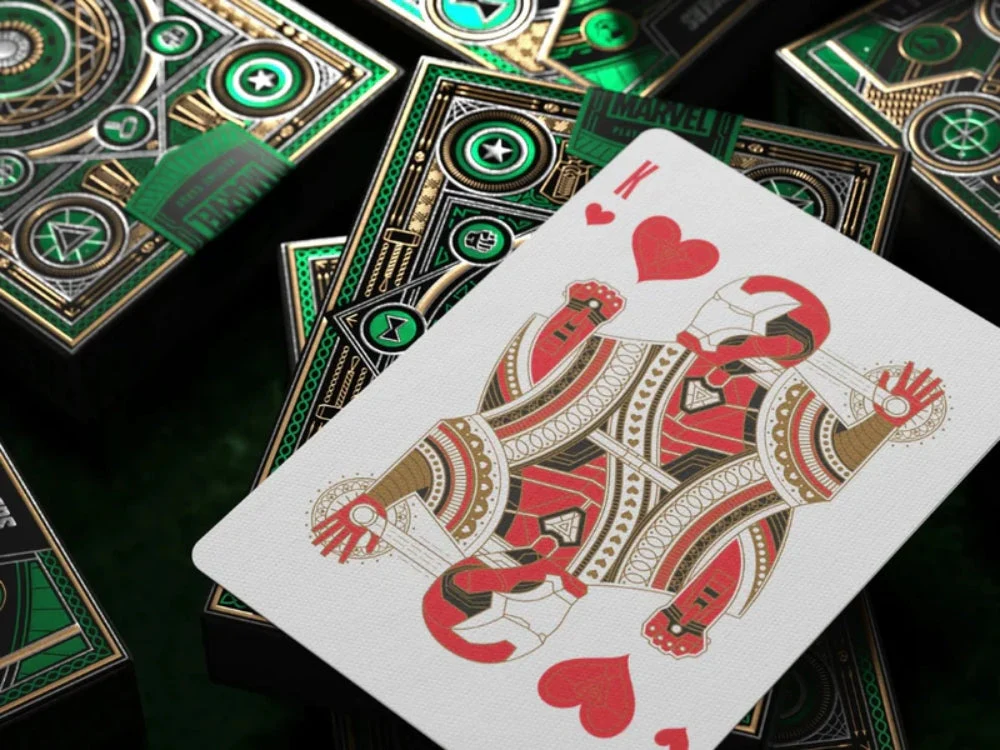
We spotted a fun one in the avengers playing cards from theory11. The King of Hearts is an Iron Man-style version, and the blaster’s pointed towards the helmet, which feels like a cheeky little remix of that iconic King of Hearts pose.
So yeah, next time you’ve got a fresh deck, go straight to the King of Hearts and see what you’ve got. Sometimes it’s the classic sword-behind-the-head awkwardness. Sometimes it’s a clever redesign.


